The Most Useful AI Agent Report: "Skipped, and Here's Why"
The biggest fear I hear from business owners about AI agents is simple: what if it makes something up? What if it says the job is done when it isn't?
It is a fair fear. Most software fails quietly. A sync stops, a form breaks, a follow-up sequence runs out, and nobody notices for weeks. If you put an AI agent on real work, you need to know what it does on the bad days, not only the good ones.
Here is the test I use: the agent worth trusting is the one that tells you, plainly, when it could not finish.
What a quiet failure costs
Picture a lead follow-up that stops on a Friday because a password changed. Nothing crashes. The leads keep coming in, and nobody gets a reply. By the time someone checks, a week of warm prospects has gone cold.
The tool did not lie, exactly. It just said nothing. For a small team, that silence is the expensive part.
An AI agent can be worse, or much better. A careless setup will fill the gap with a confident guess. A good setup will stop, say what happened, and ask for exactly what it needs.
What we saw in our own shop
Reboot Theory runs its own social media with an AI agent, under the same rules we set up for clients: it drafts, I approve, and it publishes only what I signed off.
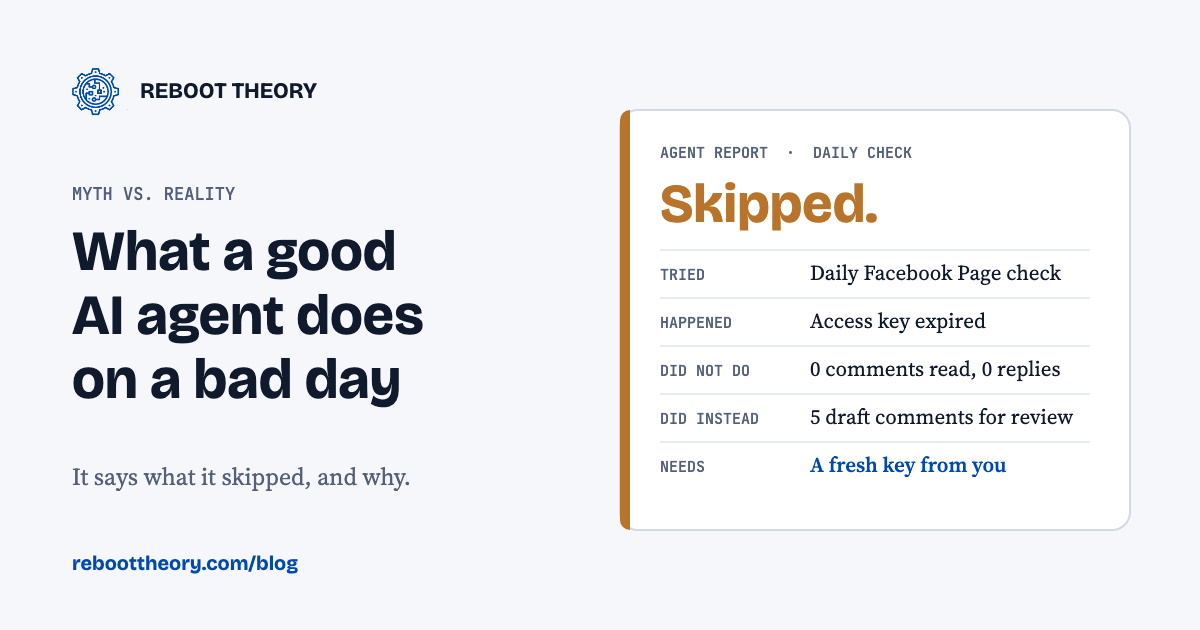
One of its jobs is a short daily check of our Facebook Page for new comments. On November 4, the access key it uses expired. From then until November 20, every weekday run came back with the same kind of report:
- what it tried (it checked the Page),
- what happened (the exact error: the key had expired),
- what it did instead (0 comments read, 0 replies sent, and 5 draft comments for me to post myself),
- what it needed from me (a fresh key).
Twelve straight runs said "skipped" out loud. None of them pretended. On November 20 we fixed it together. I did every click in Facebook's developer tools, the agent walked me through each step, and I never pasted the key into the chat. The first fix attempt did not take; deleting the stored key and adding it fresh did. The next test read the Page's latest posts. Done.
Was that a perfect three weeks? No. The point is that I always knew where things stood, because the agent told me every day.
What a good failure report includes
Whether you build an agent yourself or hire someone to do it, ask for a report with five parts:
- What it tried. The task and the system, in one line.
- What happened. The real error, word for word, not "something went wrong."
- What it did not do. Counts are best: 0 emails sent, 0 records changed.
- What it did instead. The safe part it could still finish, such as drafts for you to send by hand.
- What it needs from you. One specific ask: a new key, a sign-in, a decision.
If an agent cannot produce those five lines on a bad day, it is not ready for real work.
Three rules that make honest reporting the default
Make "skipped" an acceptable answer. Write it into the agent's instructions: if you cannot complete the task, say so and stop. An agent told to always deliver something will deliver something, even when it shouldn't.
Never let it fill a gap with a guess. No invented numbers, no made-up quotes, no "probably sent." If a fact is missing, it leaves a placeholder for you to fill in.
Keep a log you actually read. A one-line daily entry is enough. Ours lives in a shared document, and it is how I can tell you the dates above without guessing.
Why this matters before you promote an agent
We start every agent in draft mode, with a person approving each piece of work. Once it proves itself on a task, you can promote it to an AI employee that handles that step, like the send, without waiting on you.
Honest failure reporting is one of the things an agent has to show before that promotion. An agent that hides a bad day in draft mode will hide it when it has the keys, too. An agent that reports "skipped, here's why, here's what I need" has earned a little more trust each time it does.
A quick check for this week
It is a short week for many of us. Before the holiday, take ten minutes and ask of every automated tool in your business: when did it last fail, and how would I know? If the honest answer is "I wouldn't," start there.
Want an agent that tells you the truth on its bad days?
Book a free 30-minute call and we'll look at one task together.
Book a time
Allen Gradnigo is the founder of Reboot Theory, an agentic AI consulting firm in Holland, Michigan. He has 30+ years in technology and program management, is a U.S. Air Force veteran, holds a University of Michigan MBA, and is a certified PMP.